Dense Scaling Hit a Wall
For years, the recipe for better language models was simple: more parameters, more data, more compute. GPT-2 had 1.5 billion parameters. GPT-3 had 175 billion. Each generation was denser and hungrier. Scaling laws told us this worked, and it did - until the economics stopped making sense.
Training a dense 175B model costs tens of millions of dollars. Inference requires multiple high-end GPUs. Every single token activates every single parameter. It is the computational equivalent of asking every employee in a company to weigh in on every decision, regardless of relevance. At some point, you stop getting proportional returns and start burning money.
The industry needed a way to scale model capacity without linearly scaling compute. Mixture of Experts was the answer.
What MoE Actually Is (And Is Not)
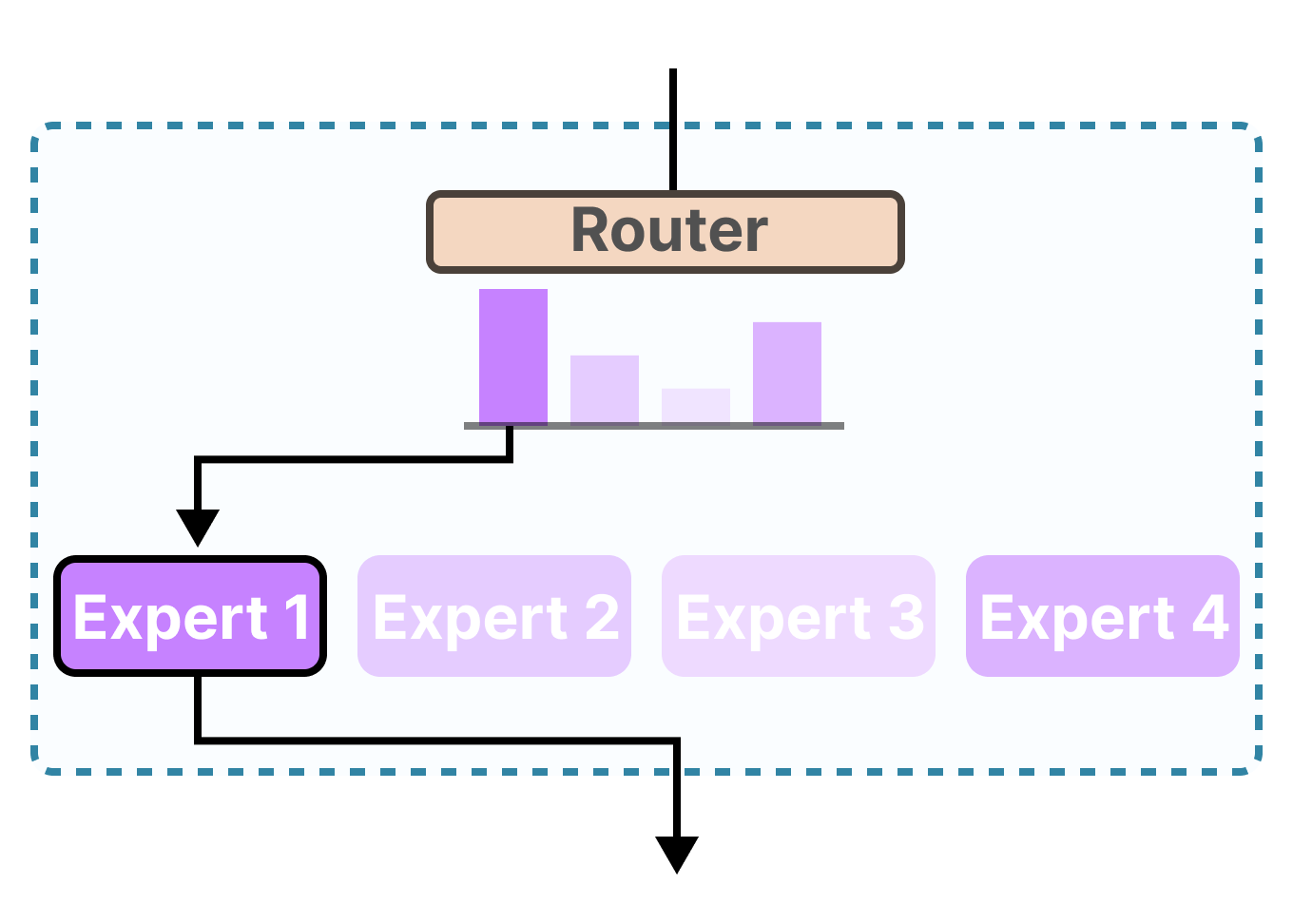
A Mixture of Experts model keeps the standard Transformer backbone - attention layers, embeddings, the works - but replaces certain dense feed-forward layers with a set of smaller sub-networks called experts. A learned router decides which experts process each token.
The name is misleading. An "expert" is not a topic specialist. There is no "math expert" or "code expert." Each expert is just a small feed-forward network that learns to activate for certain token representations. The specialization that emerges is statistical, not semantic - and researchers are still studying exactly what patterns each expert captures.
The key insight: model capacity depends on total parameters, but inference cost depends on active parameters. A model with hundreds of billions of total parameters might only activate a small fraction per token. You get the quality of a large model with the speed of a small one.
Take OpenAI's gpt-oss-120b as a concrete example. It has 120 billion total parameters but activates a fraction per token. On an M3 Ultra Mac with ~800 GB/s memory bandwidth, the inference speed tracks with the active parameter count, not the total. The model thinks like a 120B model but runs closer to a 13B one.
How Routing Works
The router is a small learned linear layer that takes a token's hidden state and produces a probability distribution over all available experts. The top-K experts (usually 2-4) are selected, their outputs are computed, and the results are combined using the router's probability weights.
This sounds simple, but routing introduces problems that dense models never face:
Load balancing. Without intervention, routers tend to collapse - sending most tokens to the same few experts while others go unused. This wastes capacity and creates computational hotspots. Most MoE implementations add an auxiliary loss that penalizes uneven expert utilization during training.
Expert capacity. Each expert can only process a fixed number of tokens per batch. If a popular expert gets too many tokens, the overflow is either dropped or rerouted. Dropped tokens during training are recoverable; during inference, they degrade quality.
Training instability. MoE models are harder to train than dense models. The router and experts form a coupled optimization problem - the router needs to learn which experts are good, but the experts need consistent token assignments to improve. Early training is especially rocky.
DeepSeek's V2 and V3 models addressed these with innovations like shared experts (a subset of experts that always activate, providing a stable baseline) and fine-grained routing that operates at a sub-token level. These techniques are now showing up across the field.
Why MoE Won
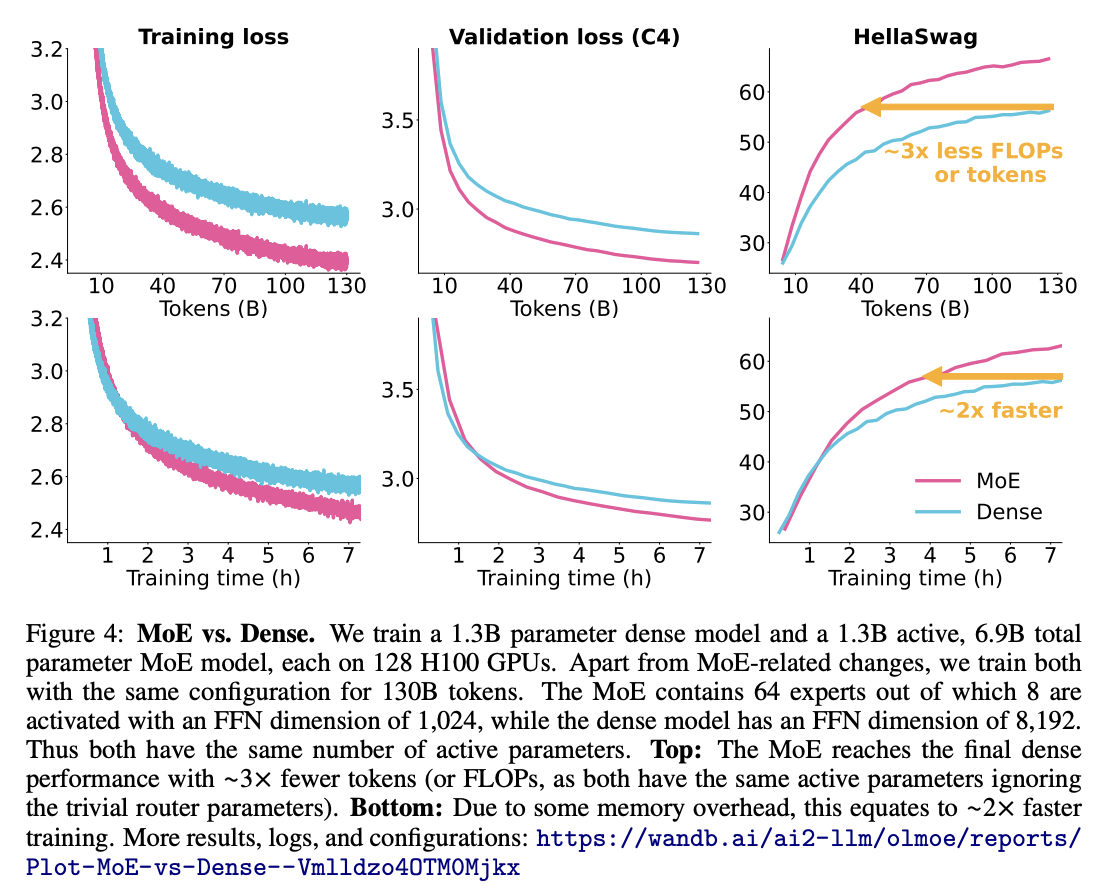
The turning point was DeepSeek R1 in January 2025. It demonstrated that a well-designed MoE could match or beat models with far higher compute budgets. The efficiency advantage was too large to ignore.
Since then, the floodgates opened. Looking at Hugging Face's MoE timeline, the number of MoE models added to the Transformers library accelerated dramatically after DeepSeek R1. Today, MoE is the default architecture for frontier models - both open and closed.
The reasons are practical, not theoretical:
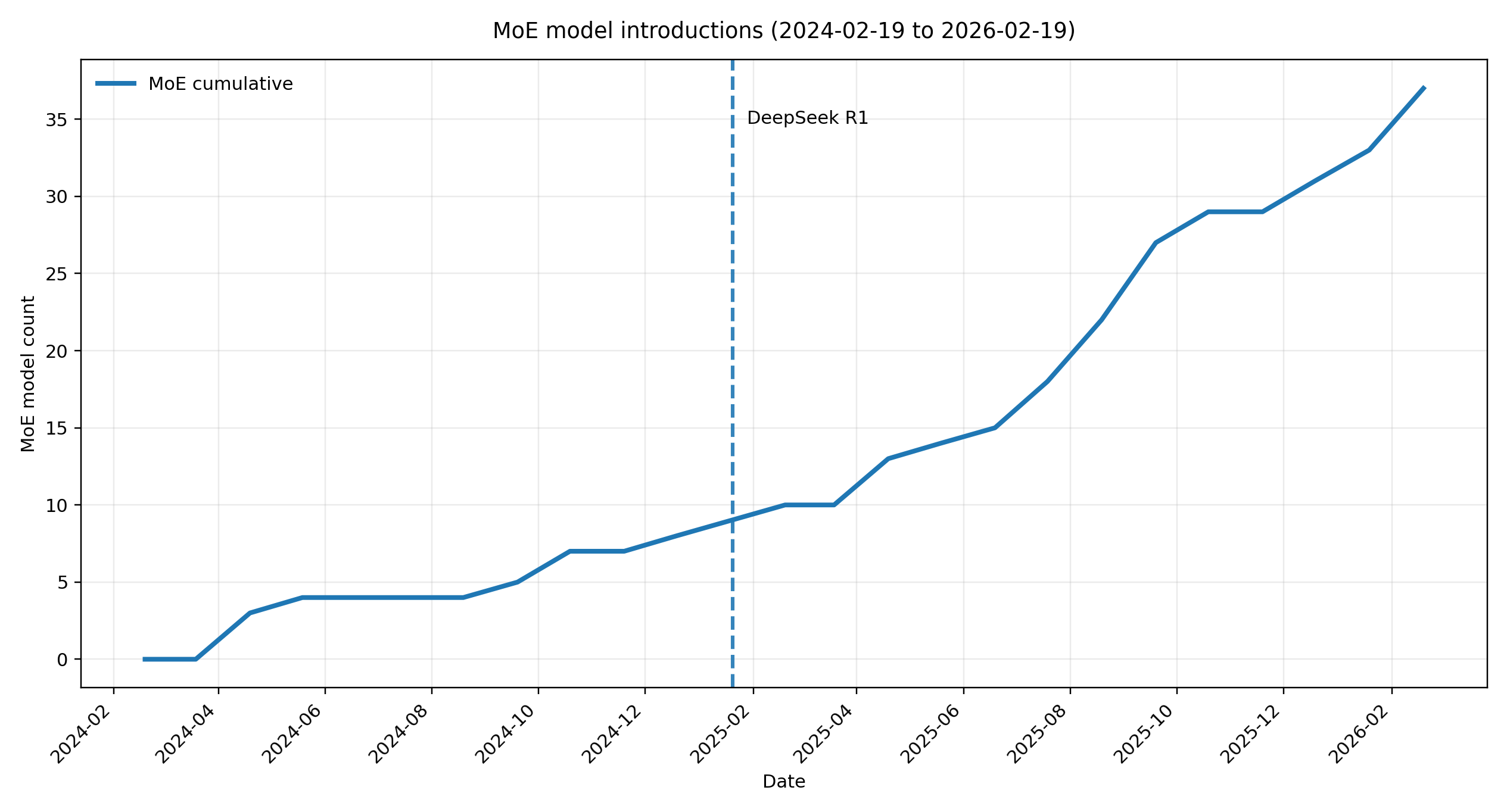
Training efficiency. Given a fixed compute budget, MoE models consistently outperform dense models of the same FLOP cost. The OLMoE paper showed this clearly - MoE training curves dominate dense ones across the board.
Inference speed. Because only a fraction of parameters activate per token, MoE models are dramatically faster at inference than their total parameter count would suggest. This matters enormously for production deployments and local inference.
Natural parallelism. Experts provide clean boundaries for distributing computation across devices. Expert parallelism - where different experts live on different GPUs - gives MoE models a structural advantage for multi-device deployment that dense models lack.
The Open-Weight MoE Landscape (February 2026)
What makes this moment remarkable is not just that MoE won the architecture debate - it is that the best MoE models are open-weight and available on Hugging Face right now. Here is a breakdown of the major releases from the past few weeks alone.
Qwen 3.5 - The New All-Rounder
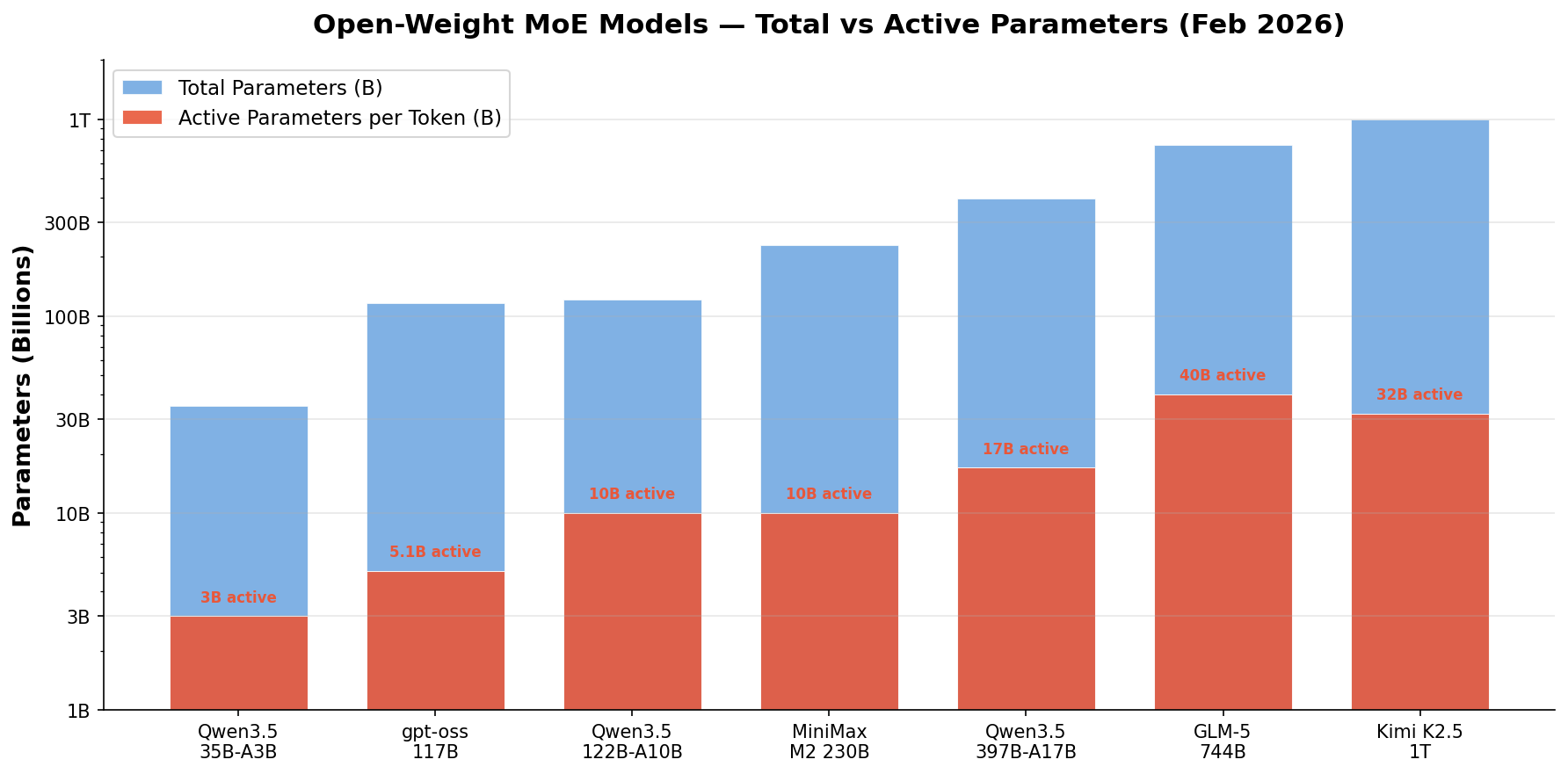
Qwen 3.5 from Alibaba dropped this week and is immediately the most versatile open-weight MoE family available. The lineup spans three MoE sizes and one dense model:
Qwen3.5-397B-A17B - 397B total, 17B active. The flagship. Multimodal (image + text). Already at 726K downloads in days.
Qwen3.5-122B-A10B - 122B total, 10B active. The practical sweet spot for serious local use on high-memory machines.
Qwen3.5-35B-A3B - 35B total, 3B active. Fast enough to run on a laptop. The active parameter count means this model can genuinely fly on consumer hardware while punching well above what a 3B dense model could do.
Qwen3.5-27B - 27B dense (not MoE). Solid baseline for comparison and for use cases where MoE routing overhead is not worth it.
The entire family is multimodal (image-text-to-text), which is notable - previous MoE releases were mostly text-only. FP8 quantized versions are already available for each size.
Kimi K2.5 - The Trillion-Parameter Open Model
Kimi K2.5 from Moonshot AI is the largest open-weight model available today at 1 trillion total parameters with 32B active. It is multimodal (with a native MoonViT vision encoder), uses MoE with 384 experts (8 selected per token plus 1 shared), and has already crossed 1.56 million downloads on Hugging Face.
A 1.1T model is not something you casually run locally - you are looking at multi-node setups or serious cloud infrastructure. But the fact that a model this large exists as open weights at all is a statement about where the industry is heading. Two years ago, a trillion-parameter model was a closely guarded secret at Google or OpenAI. Now it is on Hugging Face with an open license.
GLM-5 - Zhipu's 754B Contender
GLM-5 from Zhipu AI (the Beijing-based lab behind ChatGLM) weighs in at 744 billion total parameters with 40B active. Like the others, it uses MoE to keep inference costs manageable despite the enormous total parameter count.
GLM-5 represents the continued strength of the Chinese open-source AI ecosystem. Between Qwen, DeepSeek, Kimi, and now GLM-5, some of the most capable open-weight models in the world are coming from Chinese labs releasing under permissive licenses.
OpenAI gpt-oss-120b - OpenAI Opens Up (Sort Of)
gpt-oss-120b is OpenAI's first significant open-weight release and uses MoE architecture. At 117B total parameters with native MXFP4 quantization, it is designed to be runnable on a single 80GB GPU (like an H100 or MI300X) - a deliberate contrast to the company's usual API-only approach.
The model has 117B total parameters with just 5.1B active per token. On Apple Silicon with fast memory bandwidth, this translates to 100+ tokens per second - fast enough for interactive use. The choice to ship with native 4-bit quantization rather than relying on community quants shows OpenAI learning from the ecosystem they long ignored.
It has 3.79 million downloads and over 4,500 likes on Hugging Face. Whatever your feelings about OpenAI's open-source track record, this model is genuinely useful and genuinely available.
MiniMax M2 - The Quiet One
MiniMax M2 at 230B total parameters with 10B active rounds out the field. MiniMax has been operating somewhat under the radar compared to the bigger names, but M2 has 458K downloads and strong community reception. Worth watching as the company has been investing heavily in long-context capabilities.
How These Models Compare
To put the open-weight landscape in perspective, here is a side-by-side comparison of total parameters, active parameters per token, and what hardware you realistically need to run each model:
Running MoE Models Locally: What You Actually Need
Not all of these models are practical for local inference. Here is a realistic breakdown:
Consumer hardware (16-24GB VRAM): Qwen3.5-35B-A3B is your best bet. At 35B total but only 3B active, a 4-bit quantized version fits in ~18GB. This is genuinely capable and genuinely fast on a single GPU.
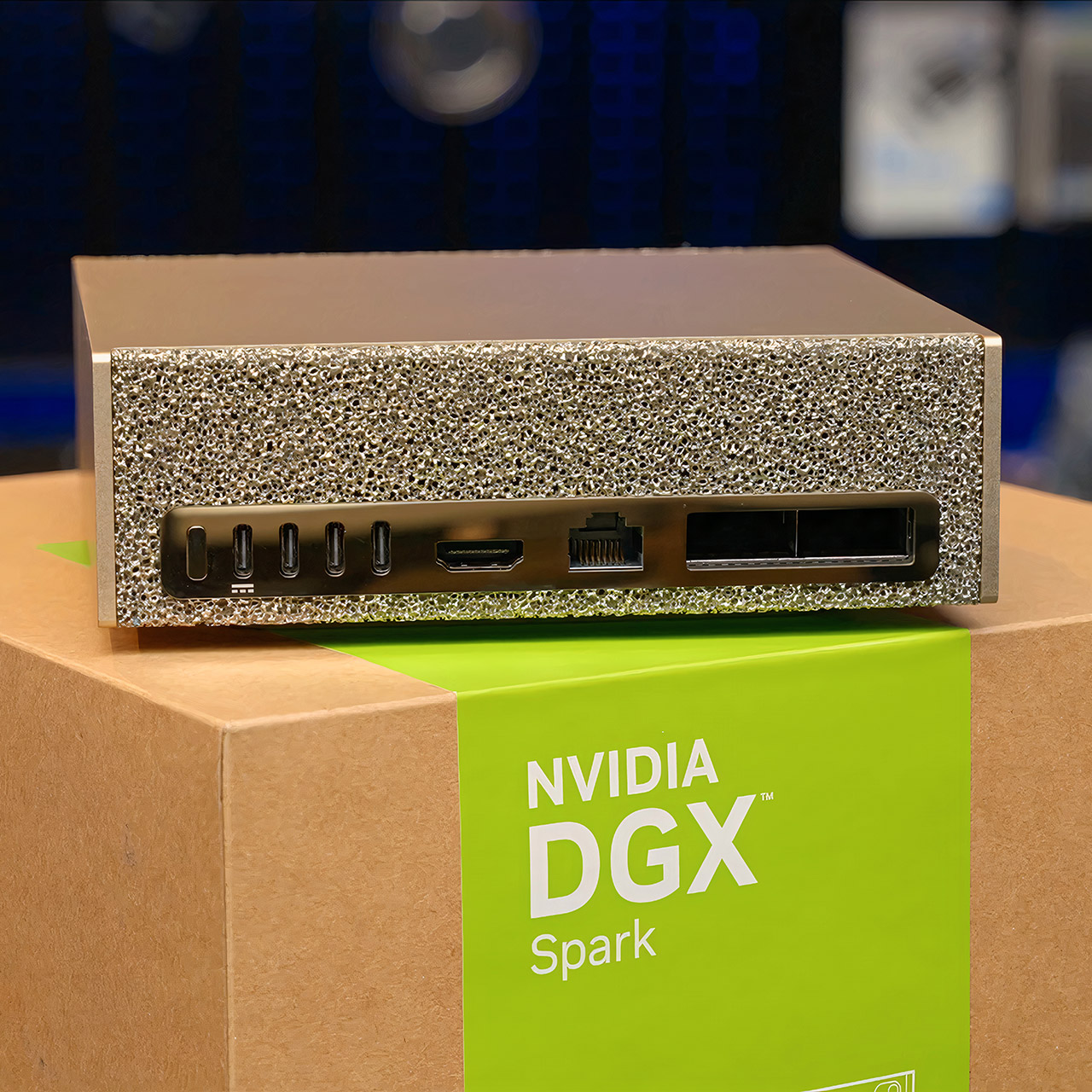
Desktop accelerators (64-128GB unified memory): This is where it gets interesting. A DGX Spark or Mac Studio M3 Ultra can handle Qwen3.5-122B-A10B at 4-bit quantization (~60GB), or gpt-oss-120b in its native MXFP4 format. The active parameter counts mean inference is fast despite the large model sizes. This is the sweet spot for serious local AI work.
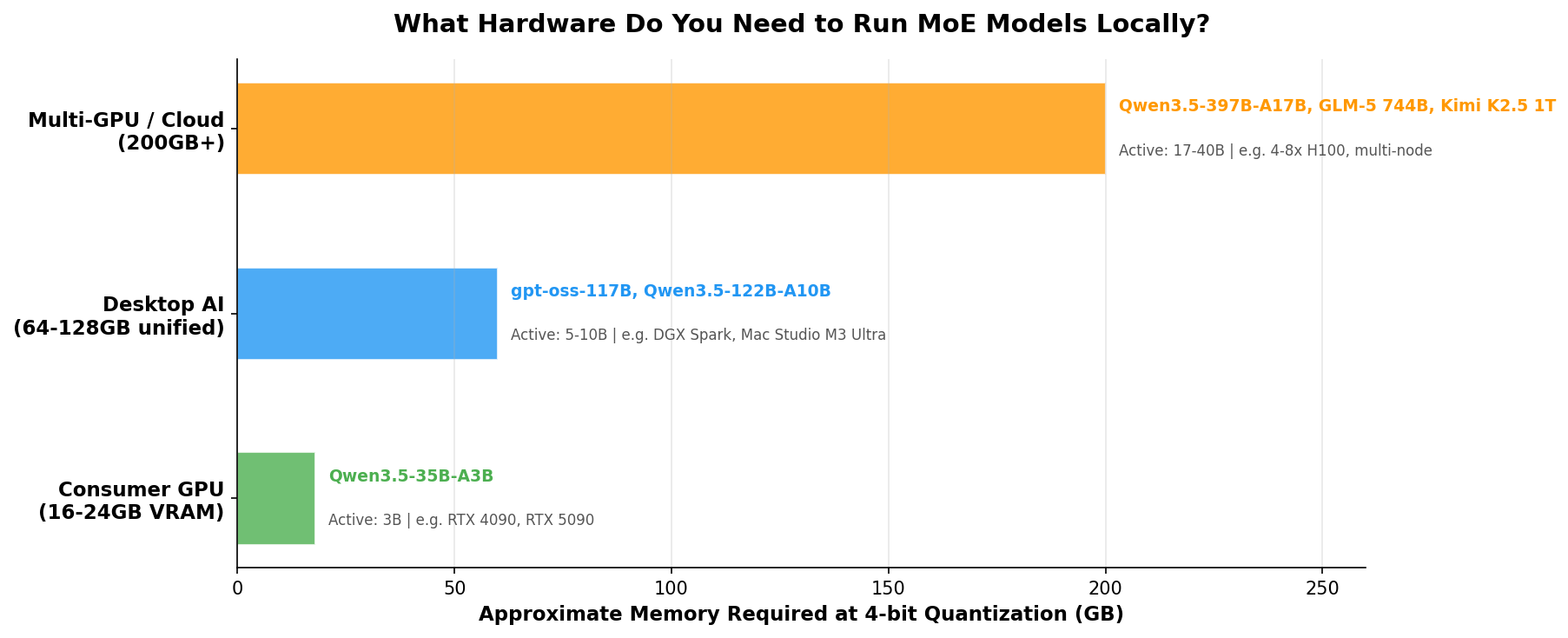
Multi-GPU / cloud setups: Qwen3.5-397B-A17B, GLM-5, and Kimi K2.5 require multi-device setups. The 397B Qwen needs ~200GB at 4-bit, so a pair of 128GB machines linked together or a cloud instance with 4-8 GPUs. The trillion-parameter models are cloud-only for now.
The tooling has caught up too. GGML (which recently joined Hugging Face) and Ollama both support MoE architectures. Running ollama run qwen3.5:35b-a3b and getting a frontier-class MoE model on a single GPU would have been science fiction two years ago.
Running models locally? If you still need cloud APIs for larger models, protect your traffic with NordVPN to keep your queries private from ISP logging and network surveillance. Affiliate link: I may earn a commission if you buy through it, at no extra cost to you.
The Engineering Challenges Behind the Scenes
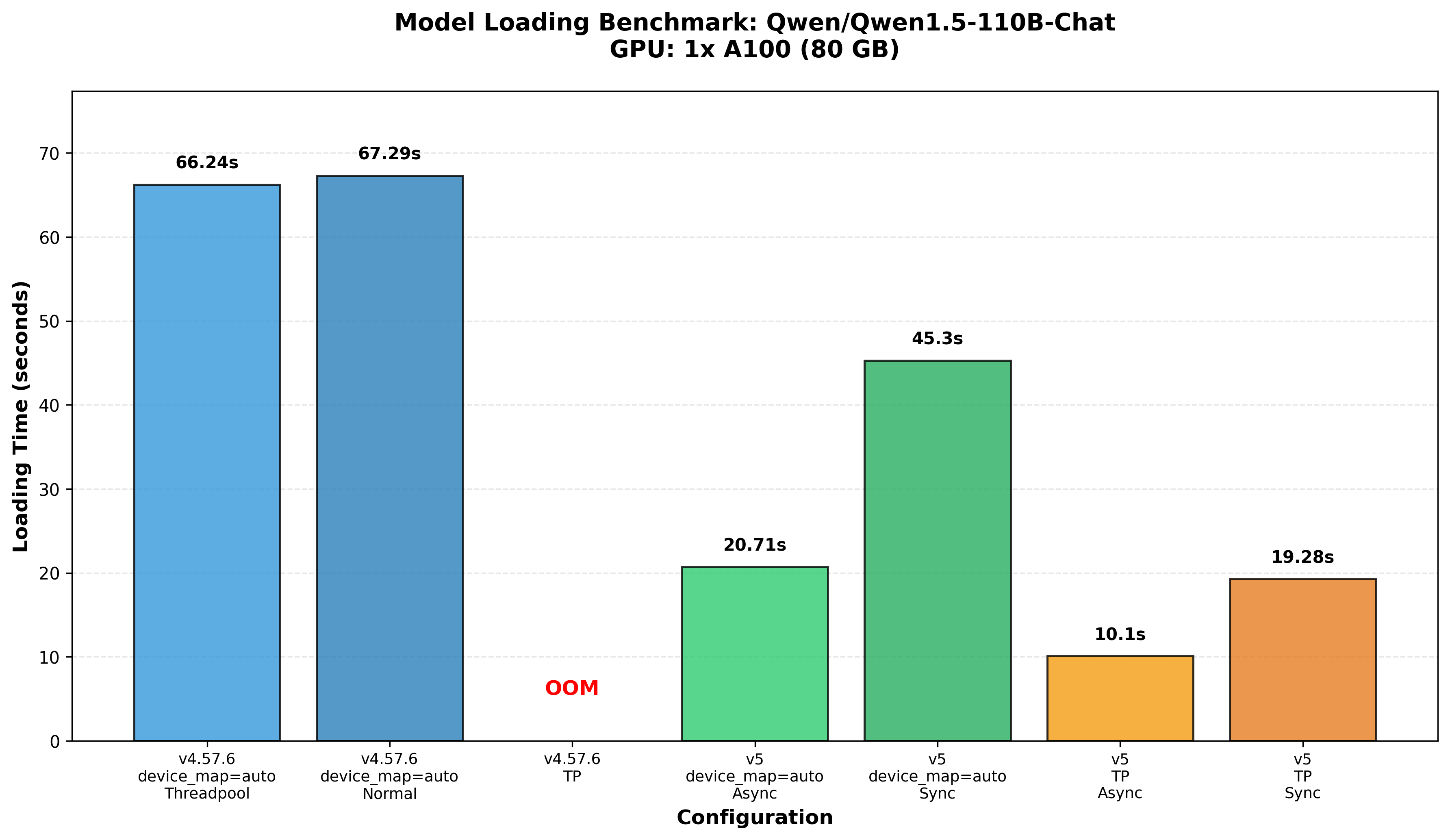
Running MoE models efficiently requires different engineering than dense models. Hugging Face's transformers library recently underwent significant refactoring to make MoE a first-class citizen. The challenges are instructive:
Weight loading mismatch. MoE checkpoints store each expert separately (256 separate tensors for DeepSeek-V3), but efficient inference kernels need all expert weights packed into a single contiguous tensor. Bridging this gap - loading 256 small tensors and repacking them into one large one - required rethinking the entire weight loading pipeline.
Expert backends. Different MoE models use different expert implementations. Some use standard grouped GEMMs, others use fused MoE kernels, and some use custom CUDA code. The transformers library now has a modular expert backend system that can swap implementations without changing model code.
Expert parallelism. Distributing experts across devices is conceptually clean but practically messy. Token routing decisions happen at runtime, so the communication pattern between devices is dynamic - unlike tensor parallelism where the communication is static and predictable. Getting this right at scale is an active engineering challenge.
Quantization complications. Quantizing MoE models is harder than dense models because different experts may have different weight distributions. A quantization scheme that works well for popular experts might degrade quality for rarely-activated ones. OpenAI's choice to ship gpt-oss with native MXFP4 sidesteps this by quantizing during training rather than after.
What This Means for Practitioners
If you work with LLMs, the MoE shift changes your calculus in several concrete ways:
Model selection is no longer about total parameter count. A 117B MoE model with 5.1B active parameters will be faster than a 70B dense model while potentially being more capable. Compare active parameters for speed and total parameters for quality.
Memory requirements are weird now. You need enough memory to load the full model (all experts), but the compute scales with active parameters. A 117B MoE model needs ~60GB at 4-bit for storage but runs like a 5B model for compute. Memory bandwidth matters more than raw FLOPS.
Local inference just got dramatically more capable. The 35B-A3B Qwen model on a consumer GPU gives you frontier-class reasoning at consumer-class speeds. The 122B-A10B on a DGX Spark or Mac Studio gives you something that rivals API models. The gap between local and cloud is narrowing fast.
Fine-tuning MoE models is still hard. Most practitioners should treat these as inference-only for now. Fine-tuning requires careful handling of load balancing losses and expert utilization. LoRA adapters on MoE models are an active research area - expect this to get easier over the next 6-12 months.
The Bigger Picture
Step back and look at the landscape: within the span of a few weeks in February 2026, we got a 1 trillion parameter open-weight model (Kimi K2.5), a 744B model (GLM-5), a multimodal MoE family from 35B to 397B (Qwen 3.5), OpenAI's first real open-weight release (gpt-oss), and a major Hugging Face infrastructure overhaul to support all of them.
This is not incremental progress. The open-weight ecosystem is now releasing models that are competitive with the best closed APIs, and MoE is the architecture making it economically viable. The combination of massive capacity with manageable inference costs means these models can be deployed by individuals, universities, and companies that could never afford to serve a dense model of equivalent quality.
The competitive dynamics are worth noting too. Chinese labs (Alibaba, DeepSeek, Moonshot, Zhipu) are leading the open-weight MoE charge, with OpenAI joining after years of keeping everything behind an API. The pressure to open up is coming from below - when a Chinese startup releases a model that matches your proprietary one, keeping yours closed stops being a competitive advantage and starts being a liability.
For ML practitioners and researchers, this is unambiguously good news. The best models in history are available as open weights, they run on hardware you can buy, and the architecture they use is well-understood and well-documented. The barrier to working with frontier-class AI has never been lower.
The age of dense-only scaling is over. MoE is the new default. And the best part is you do not need permission from anyone to use it.